
Trends & Insights
Thermos Food Jar Wholesale Guide: OEM Manufacturing, Insulation Performance & Custom Branding Explained
Apr
Why Thermos Food Jars Are Becoming a Hot-Selling Product in Global Markets
In the past few years, thermos food jars have quietly become one of the most stable product categories in the insulated drinkware industry.
We are seeing more and more importers, Amazon sellers, and retail brands adding insulated food jars into their product lines — especially for lunch, meal prep, and outdoor use.
The trend is simple:
People are moving away from disposable food containers and looking for reusable, insulated solutions that keep food hot or cold for hours.
From a wholesale perspective, this category has a few clear advantages:
- Stable repeat demand
- Easy to brand and customize
- Works well for retail, gifting, and promotional markets
But the key question is: how do you choose the right thermos food jar supplier?
Let’s go step by step.
Material Selection: What Actually Matters for Wholesale Buyers
Stainless Steel Thermos Food Jar (Mainstream Choice)
In real factory production, stainless steel dominates the market.
Most professional buyers choose:
- Inner wall: 304 food-grade stainless steel
- Outer wall: 201 or 304 depending on budget
Why it works:
- Strong insulation performance
- Durable for shipping and daily use
- Easy to pass FDA / LFGB requirements
- Better brand positioning (eco-friendly, BPA-free)
If you are building a long-term brand, stainless steel is almost always the safest direction.
Plastic Food Jars (Budget Segment Only)
Plastic insulated food jars still exist, but mainly in entry-level markets.
Advantages:
- Lower cost
- Lightweight
However, in actual retail performance:
- Heat retention is weaker
- Customers perceive lower value
- Harder to build premium branding
Most of our clients only use plastic for promotions or low-price retail chains.
Insulation Performance: What Suppliers Don’t Always Tell You
Almost every supplier will claim:
“Keeps food hot for 6–12 hours”
But in real production, insulation performance depends on several factors.
Double-Wall Vacuum Structure
The most important factor is vacuum sealing quality between inner and outer walls.
If vacuum sealing is not stable:
- Heat loss increases quickly
- Performance drops significantly in cold weather
That’s why serious buyers always request sample testing before mass production.
Real-World Testing Method (Important for Importers)
We usually suggest clients do a simple test:
- Fill jar with 95°C hot water
- Close lid tightly
- Check temperature after 6 hours
This gives a much more realistic result than just reading specifications.
Optional Upgrade – Copper Layer
Some premium thermos food jars include a copper coating inside the vacuum layer.
It helps:
- Improve heat retention slightly
- Position product as “high-end”
This is not necessary for all markets, but useful for Amazon or retail premium positioning.
Key Features That Improve Sales Performance
Small design details often decide whether a product sells well or gets complaints.
Leak-Proof Structure
This is one of the most important points for end users.
A good thermos food jar should have:
- Strong silicone sealing ring
- Stable screw lid design
- No leakage during shaking or transport
One leakage issue can damage brand reputation quickly.
Wide Mouth Design
This feature is becoming standard in most markets.
Benefits:
- Easier to fill food
- Easier to clean
- More convenient for direct eating
Most wholesalers now prefer wide-mouth designs over narrow ones.
Accessories (Spoon / Handle / Carry Bag)
Adding accessories increases perceived value:
- Foldable spoon
- Carry handle
- Insulated bag
Even small additions can help improve retail pricing.
OEM & Private Label Customization Options
For wholesale buyers, customization is where real profit margin comes from.
Logo Branding
Common methods:
- Laser engraving (premium, durable)
- Silk printing (cost-effective, colorful)
Laser engraving is usually preferred for mid-to-high-end brands.
Surface Finishing Options
Popular finishes in current market:
- Matte powder coating (best-selling)
- Glossy spray coating
- Gradient colors (trend-driven)
Matte finishes are currently dominating retail shelves.
Packaging Customization
Packaging is often underestimated.
Options include:
- Custom gift box
- Eco kraft packaging
- Retail-ready packaging with barcode
Good packaging can significantly increase shelf value.
Certifications Required for US & EU Markets
Before importing, make sure your supplier can provide:
- FDA certification (USA)
- LFGB certification (Europe)
- BPA-free material testing
For larger retailers, ISO or BSCI audits may also be required.
Skipping this step often leads to customs or compliance delays.
MOQ, Pricing & Production Reality
Typical factory terms:
- Stock model: 500–1000 pcs
- OEM custom model: 1000–3000 pcs
Pricing depends on:
- Stainless steel grade
- Insulation structure
- Surface finishing
- Packaging requirements
Practical advice:
Start with a standard model + logo first, then expand once market response is confirmed.
Market Trends in Thermos Food Jars (2026 Update)
Based on current export orders, we see 4 clear trends:
Eco-Friendly Positioning
Reusable stainless steel products continue to replace plastic containers.
Minimalist Design
Simple colors like:
- Black
- White
- Beige
- Olive green
are performing better than complex designs.
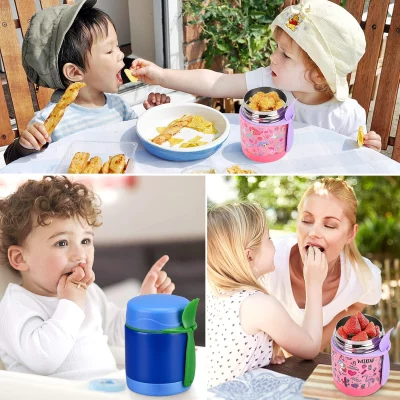
Kids & School Segment Growth
Smaller capacity jars (300–500ml) with bright colors are in strong demand.
Multi-Use Food Storage
Consumers prefer jars that can be used for:
- Soup
- Lunch
- Outdoor camping
versatility is becoming a selling point.
Common Mistakes Wholesale Buyers Should Avoid
From factory experience, we often see:
- Choosing only lowest price without testing samples
- Ignoring insulation performance testing
- Over-customizing design (causes production issues)
- Skipping certification checks
A small mistake at sourcing stage often leads to big after-sales cost.
How to Build a Successful Thermos Food Jar Product Line
Thermos food jars are not a short-term trend — they are a stable and growing category in global markets.
The key to success is simple:
- Choose stable insulation structure
- Focus on practical design
- Use proper OEM customization
- Work with experienced manufacturer
If you get these basics right, the product is very easy to scale in both retail and wholesale channels.
FAQ
Q1: What is the best material for thermos food jars?
Stainless steel (304 food-grade) is the most recommended material due to durability, insulation performance, and safety compliance.
Q2: How long can a thermos food jar keep food hot?
Most double-wall vacuum insulated food jars keep food hot for 6–12 hours depending on design and usage conditions.
Q3: Can I customize thermos food jars with my logo?
Yes. OEM customization includes logo printing, laser engraving, color coating, and packaging design.
Q4: What is the MOQ for wholesale thermos food jars?
Standard MOQ is usually 500–1000 pcs, while fully customized orders may require 1000–3000 pcs.
Q5: Are thermos food jars safe for food storage?
Yes, if made with food-grade stainless steel and certified materials (FDA / LFGB compliant).
